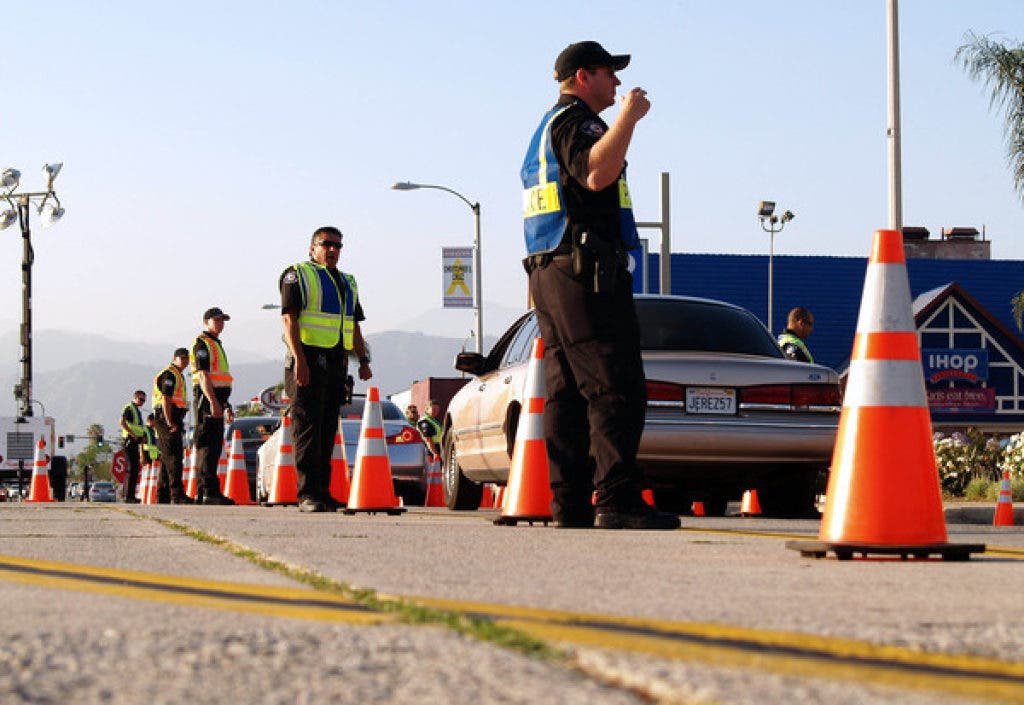
If you are charged with "driving under the influence," the charge is defined in the California Vehicle Code instead of the California Penal Code, but it's still a criminal charge that carries potential jail time for a first offense and mandatory incarceration for subsequent offenses.
The Department of Motor Vehicles can also suspend your driving privileges. And, should you get caught driving while your license is suspended for a DUI, jail time is mandated.
When pulled over for suspected driving under the influence, the officer will gather evidence to establish the probable cause necessary to arrest you for the crime. This will most likely include some testing. Balance and coordination tests, commonly called field sobriety tests, and a preliminary alcohol screening (PAS) test will most likely be requested by the officer. Although it’s generally a good idea to comply with an officer’s request, many times motorists confronted with this situation are made to believe they must comply and actually you are not obligated to do so.
Among the field sobriety tests the officer may ask you to perform are those considered "standardized."
There are three Standardized Field Sobriety Tests (SFSTs) that the National Highway and Traffic Safety Administration (NHTSA) recognizes as scientific indicators of alcohol impairment:
- Standing on one foot and balancing;
- The "walk the line and turn test";
- The Horizontal Gaze Nystagmus test (the officer is watching for the involuntary jerking of the eyes, when the eyes slowly track an object).
Each of these "standardized" tests must be explained and administered by the arresting officer accurately in order for the test results to be properly indicative of substance impairment.
A competent criminal defense/DUI lawyer must know the proper administration of these tests for proper assessment of the strength of the case and for effective cross-examination of the officer should the matter proceed to trial or a DMV administrative hearing.
A skilled defense attorney, who is most likely qualified by the National Highway Traffic and Safety Administration (NHTSA), can sometimes determine just from the face of the police report that the officer is not NHTSA-qualified, based on the recitation of his/her administration of the tests. Only an experienced defense attorney would notice this.
Upon an arrest for DUI, you are obligated to take either a blood or breath test (urine is tested if you are suspected of driving under the influence of drugs). Further, you will most likely be jailed at least to "sleep it off." Your vehicle may also be impounded.
The arresting officer will also take your license and issue you a temporary paper license, which is valid only for 30 days unless you take action to contest the DMV’s suspension of your driving privileges.
The DMV action for suspension is independent of the criminal case and is triggered simply by the arresting officer’s declaration that he/she had probable cause to arrest you for driving with a blood alcohol level of 0.08 percent or greater. It is possible to get a reduced charge on the criminal case or even no criminal filing at all but still suffer the suspension from DMV. It is therefore imperative to simultaneously defend both the criminal and administrative actions.
During the litigation of your case there are many items of discovery a skilled criminal defense lawyer knows to obtain. These attorneys also know what any given DUI arrest is worth based on the specific facts of the particular case. Plus, they know how to successfully contest the DMV’s suspension of your driving privileges.
I encourage you not to "go it alone." It’s important to have a competent defense lawyer to guard your rights; one who specifically knows DUI law and the pitfalls.
This is intended to defend against allegations of unfairly targetting any particular type of driver or vehicle. Again, all mandated as a result of prior litigation.
Also, Bob, traffic volumes are usually such that it is simply not practical (nor even desireable) to stop every single vehicle. The queue of vehicles would grow far too long, creating severe congestion and traffic hazards for other traffic in the area that is not waiting at the checkpoint.
There is a trade off. Without being able to search someone's house (with a search warrant) it would be much more difficult to acquire evidence in order to prosecute a criminal.
To drive on public roads is, indeed, a privilege, not a right, and it is a privilege granted *by* the greater society, *to* qualified individuals, and *through* its elected and appointed government. Sound good? : )
Sorry Jose, for having to put up with that stuff.... thanks for your honest input!!
They are few countries for which that is true, China, North Korea, Cuba, Iran and Venezuela to name a few. I'm just making sure people understand that here in America, we give our elected officials, the power to govern, we do not give them the power to grant privilege. That Gentlemen is a slippery slope form which their is no return.
If so, then anyone so penalized should make that argument before the Court. If they have, and if they were successful, please cite the case(s) in which that occurred. "There is no 'injured party' or 'damaged party' and so it doesn't fit the common law definition of a 'crime' per se." We are not dealing with common law but, rather, criminal law. The definiton of a "crime" in criminal law is generally accepted as: An act or omission, in violation of a public law either forbidding or commanding it, and to which is ascribed one or more punishments including but not limited to; fine, forfeiture of property, incarceration, removal from public office, prohibition from holding public office, etc. In the case of a violation of the State Penal or Vehicle Code, the injured party is the society itself...the people of a given jurisdiction. In the case of misdemeanors that can be the People of the City of Long Beach. In the case of felonies, that can be the People of the State of California. (more)
The government is fullfilling but one of its Constitutional responsibilities, in this case, to enforce all duly-enacted laws. The People elect a legislative branch which, in turn, enacts the laws. The People then also elect and appoint an executive branch (of which our police forces are a part) to, among other things, enforce the laws we have enacted. "...destroying the lives of so many of our Citizens just because they breathed over .08 on a tiny machine." I think any lives destroyed through lawful DUI enforcement has far more to do with the conscious choice to drive while intoxicated than it does with the actual enforcement of those laws. Should we just stop enforcing those laws? Will lives cease to be destroyed as a result of impaired driving if we did stop? If you consider this question rationally, I think you will agree that they will not cease to be destroyed. In fact, I think there would be considerably *more* destruction.
http://www.youtube.com/watch?v=3chtnb9ZiS0
Just so we are clear, the .08 is a politically created value that is not based on science. Their are no two humans the same when it comes to alcohol consumption. So, how does one come up with a given point, when scientifically that isn't possible?
The recommendation that all States move from.10 to .08 BAC came from the National Highway Transportation Safety Administration (NHTSA) in 1992. Here's a link to the report that agency submitted to Congress: http://www.nhtsa.gov/people/injury/research/pub/alcohol-laws/08History/1_introduction.htm It appears to me that the NHTSA based its .08 BAC recommendation on a review of 177 separate published documents of scientific research inquiring into the skills performance effects of alcohol. Here's that report (fair warning, the report on the review of the 177 scientific documents is, itself, 105 pages): http://ntl.bts.gov/lib/25000/25700/25752/DOT-HS-807-280.pdf "Their are no two humans the same when it comes to alcohol consumption. So, how does one come up with a given point, when scientifically that isn't possible?" Well, I think I've answered how NHTSA came up with their .08 BAC recommendation. You are correct that no two people are identical in how alcohol may affect them, this precisely why there are two sub-sections in the primary CA law that deals with impaired driving. Only one requires a .08 BAC and at that level the presumption is that a driver who is 21 or older is impaired. If you dislike this presumption, then work to have it changed. Either that or turn in your driver license. When you accepted it, you agreed to the presumption.
http://www.radleybagsale.co.uk
http://www.coast-dressessale.com http://www.nudiejeansonline.com
V.C. Sec 13353 Refusal of Chemical Test (b) If a person on more than one occasion in separate incidents refuses the officer’s request to submit to, or fails to complete, a chemical test or tests pursuant to Section 23612 while driving a motor vehicle, upon the receipt of the officer’s sworn statement that the officer had reasonable cause to believe the person had been driving a motor vehicle in violation of Section 23140, 23152, or 23153, the department shall disqualify the person from operating a commercial motor vehicle for the rest of his or her lifetime. The other penalties for refusal of tests: 1st DUI-- 1 yr. suspension 2nd DUI within 10 years-- 2 yr. susp. 3rd DUI within 10 yrs-- 3 yr. revocation Under 21 you can't even refuse the PAS (preliminary alcohol screening) without 1-3 yr. sanctions. The nuances of DUI law are great. The decision to not provide evidence to LE should probably be discussed with a competent DUI attorney prior to drinking and driving, but who actually does that? And, in the end, is it actually worth the risk? I suppose if you already have a prior DUI, you need to address this. Still, if you have a prior DUI, and you're still driving DUI, what's going on? Maybe the 3 month Alcohol Diversion Class didn't pay off, and another 18 months and mandatory jail time might just help-- or not.